Fueling the Engine
The Math Without the Drama
Now that we have wrung out the water weight and stabilized your system, we can address the actual tissue.
To force your body to release stored fat, you must consume less energy than your body requires to operate. Eat less than you burn, and your body pulls the deficit from fat stores. Eat more, and it stores the surplus as fat. That is the unbreakable law of thermodynamics.
Many people fear calorie counting. They think it is obsessive or stressful. In reality, math removes the drama. Without the numbers, you rely on hope and guilt. You eat a piece of bread and The Elephant (your Primal Brain) panics, convinced you have ruined everything. When you know the exact math, the panic dies.
A calorie budget works like a financial budget. You can spend it however you want, provided you do not go into debt. Numbers do not have morals. A calorie is not evil or holy. It is a unit of energy.
Hijacked Signals vs. True Intuition: In Chapter 1, I told you that your body is your most loyal ally and that you must stop treating it like an enemy. Now I am telling you to turn off your intuition and turn on a calculator. That sounds like a contradiction only until you understand what happened to your internal wiring.
Your body is a loyal ally, but right now it is speaking a scrambled language.
If you are carrying excess weight, your signals have been hijacked. Years of engineered "Bliss Point" foods, chronic stress, and sleep deprivation have chemically distorted your hunger and satiety cues. Your Elephant is receiving false alarms, reading modern stress, boredom, or mild thirst as lethal starvation. If you try to eat intuitively while your hormones are in this state, that hijacked intuition will drive you straight back into the caloric surplus that got you here.
For the next few months, you use the calculator and strict rhythms as a temporary cast for broken intuition. Cold math is doing the work of repairing your hormones. Once insulin stabilizes, The Wet Sponge drains, and the chemical noise fades, your true biological intuition will return. You will eventually be able to trust your body's signals again. But while the bone is setting, we trust the math.
You do not need a spreadsheet or a nutrition degree. Calculate your budget once, then apply The Anchor and The Lever.
Step 1: Find Your Daily Budget (The Ceiling). Your TDEE (Total Daily Energy Expenditure) is the estimated number of calories your body burns in 24 hours, including baseline survival functions and daily movement.
- Use any free, reputable online TDEE calculator. Input your current weight, height, age, and activity level. (If you only walk, select "Sedentary" to be safe.)
- The calculator returns a maintenance number - say, 2,400 calories. Eat exactly that and your weight stays exactly the same.
Step 2: Set The Deficit (The Floor). To drive fat loss without triggering the starvation alarms discussed in Chapter 1, you need a moderate, quiet deficit.
- Subtract 300 to 500 calories from your TDEE (roughly a 15-20% deficit).
- Example: If your TDEE is 2,400, your Daily Budget is 1,900 to 2,100 calories. That forces steady fat loss without destroying your energy or cannibalizing muscle tissue.
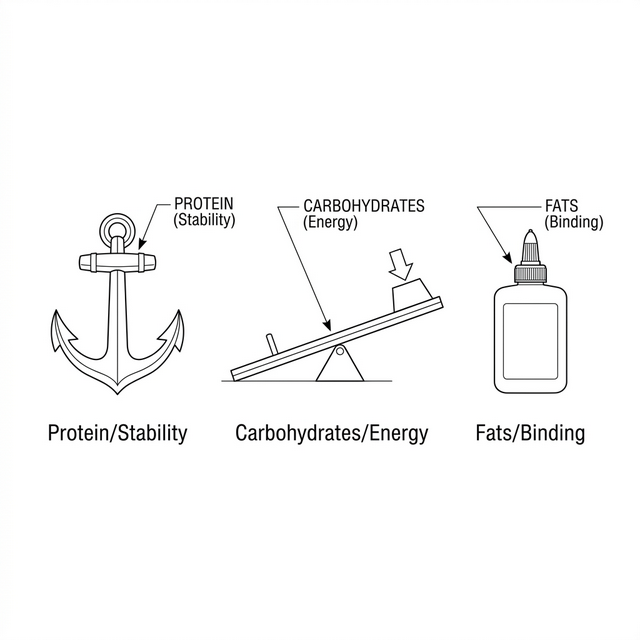
Step 3: Drop The Anchor (Protein) Protein is the biological non-negotiable. It is The Anchor of your entire diet. It preserves muscle mass so your body burns fat instead of tissue, and it mechanically suppresses hunger signals.
- The Target: Aim for approximately 1.6 to 2.2 grams of protein per kilogram of your Target Body Weight. (If your goal weight is 75 kg (165.3 lbs) / 165 lbs, that is roughly 120 to 165 grams of protein per day.)
- Why Target Weight? If you currently weigh 130 kg (286.6 lbs) / 287 lbs, calculating protein against your current weight forces absurd, uncomfortable food volumes. Body fat does not require protein to maintain - only lean tissue does. Calculate based on the body you are building.
Step 4: Adjust The Lever (Carbs) and The Glue (Fats) Once you hit your Protein Anchor, remaining calories are filled with fats and carbohydrates.
- Fats (The Glue): Required for hormone production and brain function. Warning: fat is calorically dense at 9 calories per gram. A careless pour of olive oil can erase your entire daily deficit. Measure it. Keep fats to roughly 20-30% of total calories.
- Carbs (The Lever): Carbohydrates are not evil - they are fast-acting energy. Because protein is fixed and fats are steady, carbs act as your Lever. Pull it up on hard training days; push it down to hold your deficit.
That is the entire formula. Hit your protein, stay under your calorie ceiling, and physics does the rest.
Calories determine whether you lose weight. Macronutrients - protein, fats, carbs - determine what kind of weight you lose and how you feel losing it.
- 1. PROTEIN (The Anchor)
- The Digestion Tax: Protein carries a significant metabolic advantage. Your body burns 25-30% of the calories in a piece of chicken just digesting it. It functions as a built-in biological discount.
- Sources: Chicken breast, turkey, lean beef, fish, eggs, Greek yogurt.
- (Plant-Based Note: Tofu, tempeh, lentils, edamame, and seitan work perfectly. Plant proteins are slightly less concentrated than meat, so physical portions will be somewhat larger to reach the same gram targets. The physics remain identical.)
- 2. CARBOHYDRATES (The Lever). The problem is not carbs - it is the speed at which they enter your bloodstream.
- Slow Fuel (Complex): Oats, brown rice, potatoes, beans. These are locked inside cellular structures and fiber, requiring real work to break down. The result is a slow, steady energy release that keeps insulin calm.
- Fast Fuel (Simple): Sugar, white bread, pastries, fruit juice. These hit the bloodstream instantly, spiking insulin hard. A large spike is always followed by a large crash, which wakes The Elephant and triggers cravings.
- The Fruit Rule: During active fat loss, keep fruit structured. Stick primarily to berries, green apples, and pears - the highest fiber-to-sugar options - for physical volume without the blood-sugar whiplash of tropical fruits. Always pair fruit with a protein.
- 3. FATS (The Glue) Dietary fat does not make you fat by default, but it is the easiest macronutrient to accidentally overeat.
- Sources: Olive oil, avocado, nuts, seeds, and the naturally occurring fats in eggs and salmon.
- Rule: No deep-frying. Submerging food in oil adds untrackable calories. Bake, grill, or pan-sear with a measured spoon of oil.
- 4. FIBER (The Broom) Fiber is a carbohydrate your body cannot digest, providing virtually zero usable calories.
- The Mechanics: It physically stretches stomach walls, sending a mechanical fullness signal to the brain, and slows the absorption of everything else in the meal.
- The Target: Aim for 25 to 35 grams of fiber daily. Fill half your plate with two fists of non-starchy vegetables - leafy greens, broccoli, cucumbers - at main meals.
Knowing the math means nothing if execution is chaotic. You will eat a meal or planned smaller meal every 2.5 to 3 hours while awake.
Why this specific rhythm? Biological predictability creates psychological calm.
The Metabolic Rehabilitation Phase You might wonder: if humans evolved to survive harsh famines, why does going six hours without food cause The Elephant to panic and binge?
It is not because evolution requires eating every three hours. It is because your modern diet has temporarily broken your metabolism. After years of relying on a constant drip of fast-acting carbohydrates, your metabolism has lost the ability to smoothly access stored fat. Going six hours without food in this dysregulated state causes blood sugar to drop sharply. The Primal Brain reads that chemical crash as famine. By the time you sit down to eat, The Rider is locked in the trunk and a panicked Elephant is driving straight into a wall of hyper-palatable calories.
Eating a protein-anchored meal every three hours is a blood-sugar stabilization tool. It creates a rolling wave of energy instead of violent spikes and crashes. Predictability signals safety to the nervous system and sharply reduces the urge to binge.
- Hydration: Drink 1.5 to 2.5 liters (50-85 fl oz) of water daily. Thirst is routinely misread by the brain as hunger. If a sharp craving hits between your three-hour windows, drink 500 ml of water and wait ten minutes. The "hunger" usually disappears.
(Note on Future Flexibility: This strict rhythm is mandatory for Month 1 because your metabolism is currently inflexible. The goal of these 30 days is to heal baseline insulin sensitivity and earn Metabolic Flexibility - the ability to seamlessly shift to burning stored fat when food runs out. Once that machinery is repaired, the evolutionary alarm stops sounding. You will eventually go 12 to 16 hours without food without The Elephant panicking. That is covered in Chapter 11 under Intermittent Fasting. For now, while the metabolism is healing, eat every three hours.)
This is where 90% of diets fail. People calculate their budget correctly, then estimate portion sizes by eye. The human brain is notoriously bad at estimating volume. A "handful" of nuts can be 400 calories. A "splash" of oil can be 200.
During the fat-loss phase, you will use a digital food scale. You will weigh your food and track it in an app.
Reframe the food scale immediately: it is a temporary teacher. Two weeks with a digital scale will cure portion amnesia and permanently recalibrate your brain's visual understanding of food.
There is one unbreakable rule when using the scale: weigh all solid foods raw, and all grains and pasta dry.
Why? Because cooking destroys accuracy.
- 100 grams of raw chicken breast contains exactly 23 grams of protein. Grill it and water evaporates - it may weigh 70 grams on the plate, but it still has exactly 23 grams of protein.
- 50 grams of dry oats contains roughly 190 calories. Boil them and they expand to perhaps 150 grams. Still exactly 190 calories.
Log "cooked chicken" or "cooked rice" in an app and the math will be wrong every time, because water content varies with every cook. Heat changes water volume. It does not change calories.
- Rule 1: Put raw meat on the scale. Log the raw weight.
- Rule 2: Put dry rice or oats on the scale. Log the dry weight.
- Rule 3: Measure oils and sauces to the exact milliliter or gram.
It requires effort for the first two weeks. After that, weighing food raw removes the anxiety of guessing. You stop wondering whether your metabolism is broken or your diet is failing. You look at the math, follow the rhythm, and let physics do the work.
Batch Cooking is Armor. Decision fatigue is the enemy of The Rider. If you have to decide what to cook at 7:00 PM after a brutal day, The Elephant will order takeout. Pick two proteins, two complex carbs, and a large volume of vegetables. Cook them on Sunday. Weigh them into containers. When the three-hour alarm goes off, you do not think - you open the fridge, take out a container, and eat. Routine kills chaos.
Sweeteners (The Tactical Compromise). Zero-calorie sweeteners - stevia, sucralose, diet sodas - are a tactical compromise. They contain no usable energy, so they technically preserve your mathematical deficit. If a diet soda stops you from breaking that deficit, use it. But biology is messier than math. As established in Chapter 4, highly processed artificial sweeteners can irritate the gut and drive systemic inflammation. For some people, the artificial sweet taste also wakes The Elephant and triggers violent cravings for real sugar. Monitor your response carefully. If you experience unexplained bloating (The Wet Sponge) or intensified hunger, treat sweeteners as an inflammatory trigger and cut them out.
Alcohol (The System Breaker) You might ask: if fat loss is pure physics and calories, why can't a glass of wine fit inside the daily budget?
Alcohol is not excluded because its calories defy physics. It is excluded because it acts as a neurological and hormonal toxin that breaks the exact machinery required to execute the math. It fragments deep sleep, spikes cortisol, refills The Wet Sponge, immediately halts fat oxidation, and disables the prefrontal cortex - The Rider. That combination virtually guarantees The Elephant will break your deficit the following day. You cannot optimize an engine while pouring sand into the fuel tank. Alcohol is excluded from this framework entirely.