Winning the Focus War
Mastering Your Primal Brain
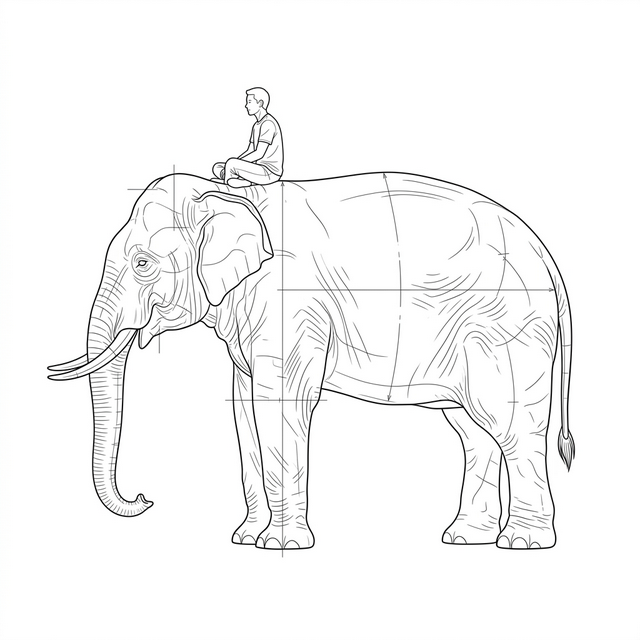
Before you can win the focus war, you need to understand who is actually fighting it.
Inside your skull, you do not have one unified mind. You have two very different operating systems forced to share the same space, pulling on your behavior from opposite directions.
The first is your Human Brain - the prefrontal cortex. Logical, patient, capable of long-term strategy. It is the part of you reading this, setting goals, planning meals, and wanting to feel proud of your reflection a year from now. Call this part The Rider.
The second is your Primal Brain - the limbic system. Emotional, impulsive, and ancient. Its mandate is to keep you alive today, not disciplined tomorrow. It does not care about your waistline, your long-term health, or your abstract future happiness. It cares about survival, right now. Call this force The Elephant.
That divide is why The Rider calmly decides, "We are eating better starting Monday," and The Elephant immediately replies, "Understood - but right now I am stressed, and there is pizza."
The Rider can steer, analyze, and reason - but only as long as The Elephant agrees. When The Elephant gets scared, hungry, exhausted, or stressed, it stops taking orders. It runs toward the nearest source of safety and dense pleasure, and The Rider hangs on wondering why they "lost control" again.
The Elephant is not evil, and it is not stupid. It is perfectly optimized for the year 10,000 BC. It evolved to keep you alive in an environment where food was scarce, predators were real, and comfort was rare. Today, hyper-palatable calories are available around the clock. When your instincts push you to consume more than you need, that is not weakness. It is ancient wiring still preparing for famine.
When you fully internalize that, the guilt begins to dissolve. You stop asking the punishing question, "What is wrong with my willpower?" You start asking the tactical one: "What is my Elephant reacting to right now?"
This is where The Willpower Lie traps you. It tells you to fight harder - as if a fragile Rider could overpower a panicked Elephant by pulling the reins and shouting louder. You do not control millions of years of evolutionary instinct with brute force. You guide it.
You win the focus war by deciphering the signals driving your behavior, not by pretending they do not exist. When you stop treating your Primal Brain like a defective enemy and start treating it like a powerful, easily frightened ally, the internal war begins to end.
Try a psychological experiment right now: do not think about a slice of chocolate cake.
Do not picture the frosting. Do not imagine the smell of vanilla or the softness under a fork.
What just happened? You thought about the cake - probably more vividly than you have all day. That is not a failure of discipline. It is a documented cognitive mechanism known as Ironic Process Theory.
Your attention operates like a Spotlight. It is the main tool The Rider uses to guide The Elephant. Whatever the beam touches gets brighter, heavier, and more dominant in your mind. The problem is that the brain does not handle the word "not" the way you think it does. The harder you try to push a thought out of the light, the more energy your brain spends checking whether it has returned. In trying not to think about the cake, you keep the cake fully illuminated.
This is The Spotlight Rule: tell your brain not to focus on a threat or a craving, and it locks onto it. It is like telling a child, "Whatever you do, do not push that red button." You have just made the button the most interesting object in the room.
That is the paradox behind chronic cravings. You swear off sugar, and suddenly every billboard, bakery smell, and grocery aisle glows like a signal flare. Your Primal Brain thinks it is helping by monitoring the threat. In reality, it is keeping you chained to the exact thing you are trying to escape.
You cannot un-think a craving. You can only redirect The Spotlight.
Picture a dark theater with one bright beam of light. You cannot turn the lamp off. Your Primal Brain naturally aims it at immediate pleasure, food, and comfort. Your Human Brain wants to aim it at progress, stability, and peace. The Rider cannot carry The Elephant. The Rider can only aim The Spotlight. And The Elephant will walk toward whatever The Spotlight keeps illuminating.
Any plan that simply tells you to avoid bad food without giving you a concrete, superior target is biologically doomed. The Elephant hates a vacuum. The moment you say, "No sugar," the survival brain asks, "Then what?"
What you actively resist actively dominates your awareness.
The Willpower Lie tells you to fight the craving head-on - stare into the light, say no, and hold out until exhaustion defeats you. That is not how obsession is broken. You do not beat it through suppression. You beat it through substitution. You need a more compelling target for your Spotlight.
The next time you catch yourself fixating - on junk food, on guilt, on the scale - do not shout "stop." Whisper "shift." Turn the beam toward water, a walk, a specific task, a slow breath. Anything that tells your brain: this is where we are going instead.
If your focus is The Spotlight, then triggers are the unseen hands trying to steal the lamp.
The Primal Brain does not wake up because you decided to change your life, and it does not care about motivational quotes. It activates around two things: threats and temptations. Stress, loud environments, unpredictable routines, anything that historically signaled danger or fast relief.
That is why, after weeks of clean eating and real insight, one chaotic day at the office can throw you back into old habits. You did not lose control. Your ancient wiring perceived a threat, hijacked The Rider, and took the wheel. You will never out-reason a limbic system in survival mode. You can only build an environment that feels safe enough for it to stand down.
Four Triggers That Hijack The Spotlight
- 1. Stress - The Chemical Alarm System
When you are stressed, the HPA axis floods your bloodstream with cortisol and adrenaline. Those hormones evolved to mobilize fast energy so you could fight or outrun a predator. Today the "predator" is a deadline, an argument, or a bad email, but your Primal Brain still demands dense calories for the physical fight it thinks is coming. Telling yourself to calm down does not lower the biological volume. Movement does. Stand up. Step outside. Breathe. Every slow exhale tells the nervous system: we got out. We are safe now.
- 2. Uncertainty - The Fear of the Future
When you do not know whether your efforts will pay off, anxiety rises. The brain hates the unknown and tries to self-medicate with a guaranteed dopamine hit - usually junk food. The antidote to uncertainty is knowledge. When you understand the physics of energy balance and the biology of your metabolism, panic drops. You stop bargaining with the outcome and start trusting the math.
- 3. Ambiguity - The Empty Present
Uncertainty is fear of tomorrow. Ambiguity is the absence of clear instruction right now. The mind hates a vacuum. If you open the fridge at 8:00 PM thinking, "What should I eat?" you are already behind. Without direction, The Elephant defaults to least resistance. "I will try to eat healthy today" becomes "I will eat whatever smells good at 1:00 PM." Structure kills chaos. "I am eating protein and oats at 9:00 AM. I am walking at 1:00 PM." Specificity kills drift.
- 4. Sensory Triggers - The Modern Jungle
Your ancestors stumbled across dense calories maybe once in a season. You encounter them every few minutes - Instagram ads, checkout aisles, office break rooms. The answer is not stronger willpower. It is environmental curation. Keep real, protein-anchored food visible. Keep hyper-palatable food out of your house when possible. Your environment speaks to your Primal Brain more loudly than your logic ever will.
Most people underestimate how much not knowing what to do next drives self-sabotage. Mild hunger can feel like an emergency to The Elephant. Fatigue can feel like total collapse. Structure starves the Primal Brain of panic because predictability signals safety.
Your first tactical move is not to grit your teeth. It is to quiet the battlefield. Sleep enough. Plan the next meal. Clear the junk from your counters. Clarity - not clenched fists - brings peace.
Because the brain hates a vacuum, if you do not explicitly tell it what to want, it defaults to what is easiest. You cannot suppress primal urges forever. But you can drown them out with a signal that matters more.
This is your Brighter Light: a vision of your life - and more importantly, your identity - strong enough to pull The Spotlight away from your old habits on its own.
Your attention is metabolic fuel. Whatever neural pathway you feed grows. Focus on avoiding bad food, and the craving pathway thrives on the energy of restriction. Focus on who you are becoming, and the chemistry begins to shift. Think of it as two fires burning inside you: one is craving, the other is vision. You do not extinguish the first by stomping on it. You starve it by feeding the second.
This is not positive thinking. It is neuroplasticity. Mental rehearsal and visualization activate many of the same motor and reward pathways as physical execution. When you vividly picture waking up clear-headed, or walking past a bakery without negotiating with yourself, you are priming your brain to execute that behavior. You are teaching it that the new path carries the better reward.
The Elephant does not respond to lectures, guilt, or spreadsheet math. It responds to imagery and repetition. Give it an image it can anchor to.
There is only one psychological force stronger than primal desire: identity.
"I am trying to eat healthy" is a weak signal. It implies a temporary struggle. It leaves the old habit waiting in the background for when the diet ends.
"I am someone who values my energy and controls my environment" is a stronger signal. It quietly makes the old habit incompatible with who you are.
When you anchor your identity in mastery and self-respect, you stop fighting the old focus directly. The bad habit starts to feel out of alignment, then beneath you, then foreign. You do not have to scream at it. You become incompatible with it.
Philosophy without execution is entertainment. Until you explicitly name your Spotlight Magnet - the cue, emotion, or environment that repeatedly hijacks your attention - you will spend your life shadowboxing. And until you forge your Brighter Light, The Rider has nowhere to steer The Elephant when it panics.
Do not treat this as passive reflection. Treat it as operational work for the next time your instincts try to take the wheel.
Phase 1 - Identify The Spotlight Magnet. Isolate the cue that repeatedly hijacks your Elephant.
- What time of day, or what specific environment, triggers your most persistent craving?
- What emotion immediately precedes it? Stress, exhaustion, anger, loneliness, boredom?
- What real biological or psychological need is hiding beneath the food? Comfort, a break, a sense of control, human connection?
- Note: These underlying needs are not your enemies. They are diagnostic clues. The Primal Brain is asking for something real. It is just using ultra-processed food as a blunt instrument to get it.
Phase 2 - Forge Your Brighter Light. Build the rival image. Picture your future self operating inside the physical rhythm you are trying to create.
- What physical sensation excites you most about mastering this? Waking up without a bloated stomach? Steady energy at 3:00 PM? The absence of brain fog?
- What specific, daily act of discipline will give you the clearest sense of pride?
- Note: Do not aim for an airbrushed fantasy. Aim for a raw, honest reality your brain can actually anchor to.
Phase 3 - Map the Substitution. Decide exactly how your Brighter Light will meet the need your old habit was only imitating.
- Old Hijack: 'I crave engineered sugar when the workday overwhelms me.' New Shift: 'I need biological calm - so I step outside for a 10-minute walk that actually lowers the stress chemistry.'
- Old Hijack: 'I overeat late at night because the house is quiet and I feel lonely.' New Shift: 'I need connection and decompression - so I call someone, put on a podcast, or journal.'
- Old Hijack: 'I want drive-thru because I am exhausted.' New Shift: 'I want the relief of waking up tomorrow knowing I ate the protein I prepared for myself.'
Notice the mechanics: you are not just saying no to food. You are saying yes to the state that actually solves the problem.
Phase 4 - Install the Code. The Primal Brain ignores logic but respects consistency and proof. You must lay new tracks.
- Read your exact New Shift statements every morning for seven days.
- Hold the feeling of your Brighter Light in your Spotlight for 30 uninterrupted seconds.
- Repeat immediately after your midday meal.
Repetition tells the nervous system: this is our new dominant pattern. Feed the image, and eventually the image starts feeding you.
The effortlessly thin often have naturally stronger satiety signaling that tells them to stop eating long before you do. Many also have higher levels of NEAT - Non-Exercise Activity Thermogenesis - fidgeting, pacing, burning hundreds of extra calories without trying. It is like starting the race several steps ahead.
Born for Famine, Living in a Feast
Your body evolved to protect you from starvation. It is an efficient energy-storage machine. Today, that survival machinery is colliding with a 24/7 food environment. When your body stores fat easily in that environment, that is not a failure. It is an adaptation doing its job in the wrong setting.
You are not broken. You are running excellent ancient code in the wrong environment. And one quiet truth: even the effortlessly thin carry their own private chaos. Genetic luck is real, but it is fragile, and it does not outrun time forever.
The heaviest anchor keeping you from starting is not laziness. It is the fear that getting healthy means becoming miserable.
Food is comfort. It is stress relief. It is a reliable constant at the end of a brutal day. The idea of giving up your favorite ultra-processed foods can feel like grief. Culture has taught you to believe pleasure and health are enemies, and you do not want a joyless life.
But when I stopped dieting and started living differently, something fundamental shifted in my brain's chemistry.
Engineered foods hijack reward circuitry, delivering a massive artificial dopamine spike followed by a crash. But those same pathways were built to fire for sunlight, deep sleep, music, and the quiet satisfaction of keeping a promise to yourself.
When you step away from chemical noise, blood glucose stabilizes, sleep deepens, and hormones settle. The world regains texture. The physical lightness in your body becomes its own reward.
You do not lose joy. You diversify it. The rented high of a sugar rush fades in an hour and leaves a deficit. What you build through rhythm stays yours.
Few psychological pains cut deeper than believing your own body has turned against you. You feel like you are doing everything right - eating clean, tracking meals, pushing through hunger - and the scale refuses to move.
This is where The Willpower Lie does some of its quietest damage. It tells you that you are simply not trying hard enough at the exact moment your body is working overtime to protect you.
When you hit a weight-loss plateau, your body is not malfunctioning. It is protecting you from what it perceives as starvation. This is a clinically documented defense mechanism called adaptive thermogenesis.
Because you are taking in less energy, your body assumes famine. It responds by reducing movement so you burn fewer calories existing. Thyroid output eases. Leptin falls. Ghrelin rises. You move less and hunger for more by precise evolutionary design.
Stop talking to your body in threats. Stop trying to starve it into submission. It needs steady protein, real sleep, and consistent fueling to feel safe enough to release stored fat. Give it rhythm, and the resistance starts to drop.
The patterns should be visible now - the quiet assumptions that made every past attempt heavier than it needed to be.
You were never just battling calories. You were battling the false psychological story wrapped around them.
The five myths that fed your frustration - The Magic Bullet, The Motivation Myth, Effortless Thinness, The Misery of Change, and The Broken Body - each eroded your trust in yourself. Drag them into the light and they begin to lose their authority.
The truth is quieter: you were not broken. You were misled. Your biology has been waiting for a better conversation.
That is exactly where we go next. You have stopped believing the wrong story. Now we begin building the right one.