The First 30 Days
Lock the Rhythm
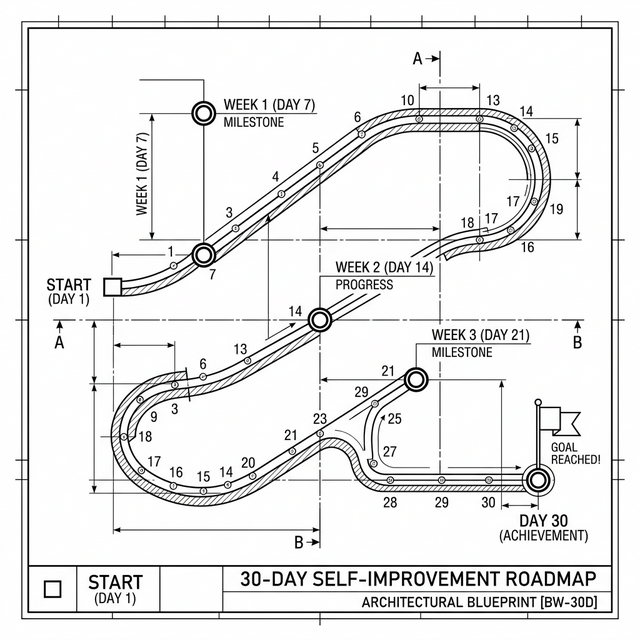
You now have the entire biological framework required to change your body. Now, you execute.
You do not need a new life today. You need one calm day, repeated thirty times.
If you try to optimize your macros, join a gym, start a complex fasting protocol, and cut every food you love all on the same Monday, you will fail by Thursday. The Elephant will panic at the restriction and take the wheel.
For the next 30 days, the noise drops to zero. No complex optimization. No advanced tweaks. We are pouring the foundation of your metabolic house.
Your objective this month is to use organizational willpower upfront - batch cooking on Sundays, setting alarms, weighing food - so that daily behaviors become automatic and require no defensive willpower to execute. When the plan is fixed, internal negotiation dies, decision fatigue falls, and The Rider can finally rest.
In Chapter 3, we established the "70% Rule" - the principle that a good-enough effort executed consistently will always beat a flawless effort that crashes. You might wonder how that flexible philosophy fits with rigid rules like using a digital food scale and strict 3-hour alarms.
Here is the distinction: The 70% Rule is how you survive the rest of your life. Month 1 is a temporary clinical baseline.
For the next 30 days, we demand precision not to test your moral character, but to gather accurate data, cure your portion amnesia, and rehabilitate your metabolism. We are calibrating the machine so you can afford to be flexible later.
Parameter 1: The 2.5 to 3-Hour Rhythm. You will eat a meal, or a planned smaller meal, every 2.5 to 3 hours while awake.
- The Execution: Set five alarms on your phone right now. When the alarm goes off, you eat. You do not wait until you are starving.
- The Biology: This mechanically flatlines blood sugar and prevents the violent insulin spikes that trigger panic-hunger. It is your metabolic rehabilitation.
Parameter 2: The Math and The Anchor. You will hit your protein target (The Anchor) at every meal, and you will use a food scale to keep your Caloric Deficit accurate.
- The Execution: Calculate your deficit once. Use a digital food scale. Weigh all solid foods raw, and all grains and pastas dry before cooking.
- The Psychology: The food scale is not a lifelong purity test. Human eyes are poor at estimating volume. The scale is a temporary scientific tool to recalibrate your visual sense of portion size and confirm that physics is actually working in your favor.
Parameter 3: The Flush. You will drink 1.5 to 2.5 liters (50-85 fl oz) of water every single day, keep your salt intake steady, and you will walk.
- The Execution: Drink 500 ml immediately upon waking. Drink a glass before every main meal. Build to a daily floor of 7,000 to 10,000 steps.
- The Biology: This keeps the lymphatic system moving, stops the body from hoarding water (The Wet Sponge), and supplies the oxygen required to burn fat.
Applying the 70% Rule: If you execute these three parameters with 70% consistency, the compounding physics of fat loss will work. If you have a bad day, get stuck in a meeting, and miss an alarm by an hour, you do not panic. You do not double your next meal. You drop to the floor - drink water, eat one protein meal, reset the 3-hour clock - and resume the rhythm. Data over drama.
In Week 2 or Week 3, The Elephant is going to try to trick you.
The initial drop in water weight will stop. The scale might flatten or even nudge up because you ate a saltier meal or had a hard day. The Elephant will scream: "The diet stopped working. Cut 500 more calories. Start running 10 kilometers a day."
You will do none of those things.
Do not tweak the math or add intense exercise during the first 30 days.
Why? Because your biology needs three to four weeks to physically adapt to a new caloric baseline. Satiety hormones and cortisol levels are actively recalibrating. If you slash calories in Week 3, you are reacting to a temporary fluid shift - The Wet Sponge - not a metabolic stall.
Treat Month 1 as a scientific experiment. Change the variables before the baseline is set and you never allow insulin to find a flat level or The Wet Sponge to fully wring out. Let the math work. Physics does not operate on your emotional timeline.
During Month 1, you are strictly a data collector. Use the exact system from Chapter 4:
- 1. The Single Daily Win (Daily): Every night before bed, ask yourself one question: Did I execute the Three Rules today? If yes, give yourself one binary tick. If no, write "Not yet" and go to sleep. No punishment. Resume the rhythm at the next meal.
- 2. The Weekly Average (Weekly): Step on the scale exactly three mornings a week - Monday, Wednesday, Friday works - after using the bathroom and before eating or drinking. Write the numbers down. On Sunday, add them and divide by three. Compare this weekly average to last week's. Never react to a single day.
- 3. The Tape Measure (Day 1 and Day 30): On Day 1, take a photo in the mirror and measure your waist. Do not look at either again until Day 30.
For the entire first month, you are proving to yourself that you can follow a system without panicking. You are rebuilding trust between The Rider and The Elephant.
If you have to cook five times a day, you will quit by Wednesday. The execution of the Three Rules needs to be frictionless.
The Rule of Two: Every Sunday, cook exactly two protein sources, two complex carbohydrates (The Lever), and a large amount of vegetables.
- Example: Bake a tray of chicken breasts and a tray of tofu. Boil a large pot of brown rice and roast a tray of sweet potatoes.
Store them in large glass containers in the fridge.
When your 3-hour alarm goes off on Tuesday at 12:30 PM, you do not think. You open the fridge. You put one portion of protein, one portion of carbs, and a handful of vegetables into a bowl. One measured teaspoon of olive oil. Microwave. Eat.
Four minutes.
Is it boring? Yes. That is the point.
When food becomes boring, it stops being entertainment or emotional comfort and returns to its biological function: fuel. A highly entertaining diet - complex recipes, exotic ingredients every night - is fragile. One late meeting will shatter it. A boring diet is bulletproof.